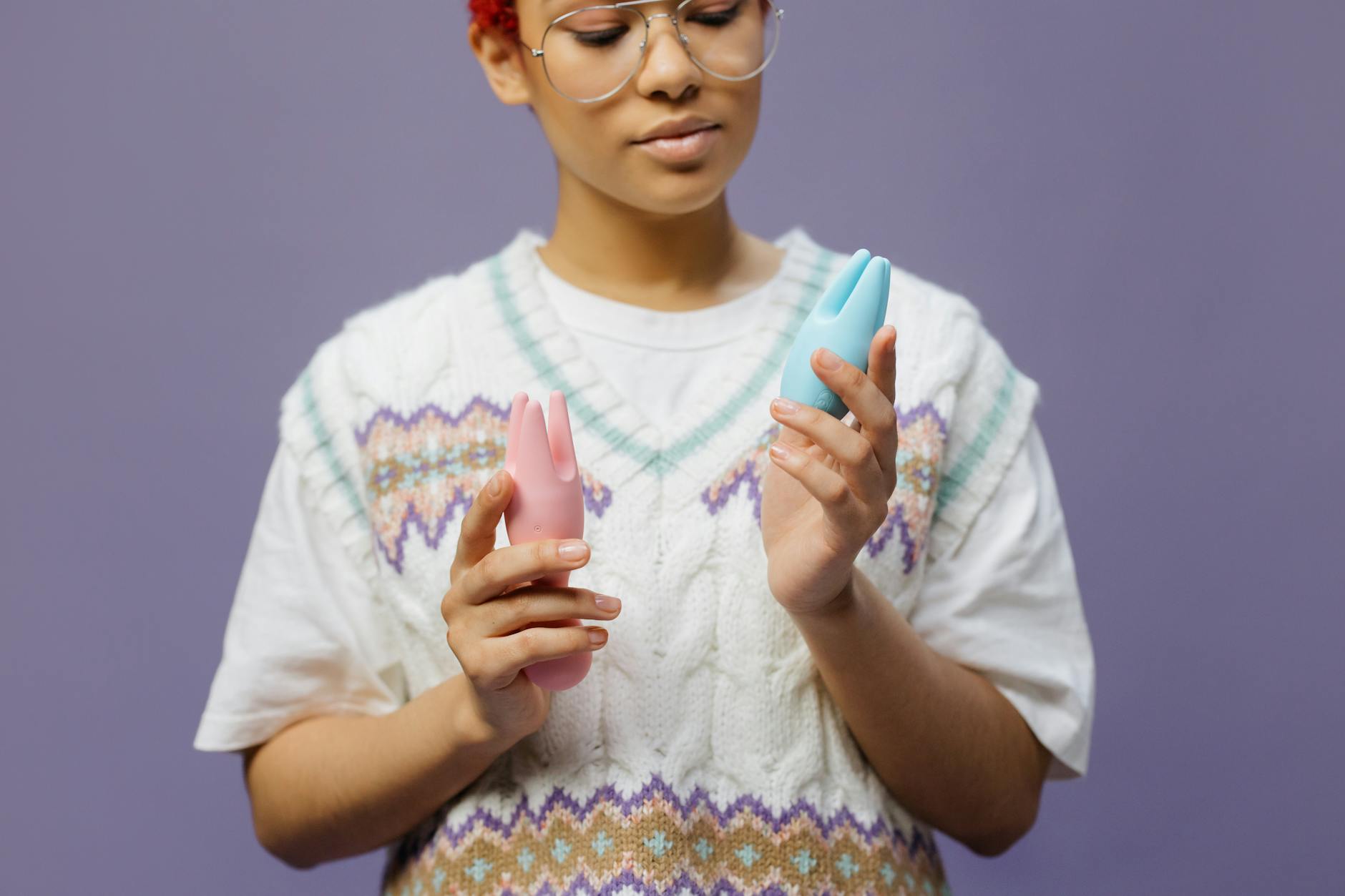
Let's start with what's actually happening
Your libido isn't inconsistent. It's responding exactly as it should. The maddening part is that "should" includes wild swings. Desire surges, then flattens. One week you can't keep your hands off your partner or yourself, the next week you feel nothing. You're not broken. Your hormones are doing their job, and your body is keeping score.
Here's what changes across your cycle, and why a lemon clitoral vibrator works differently depending on where you are in it.
How your cycle shapes arousal (the science part, made simple)
Estrogen and testosterone don't stay constant. They rise and fall in roughly four-week patterns, and each hormone influences not just desire but how sensitive your body is to stimulation.
During the follicular phase (days 1-14 of your cycle), estrogen climbs. You'll likely notice an uptick in motivation to have sex, more interest in exploring, faster arousal. Tissues get more blood flow. Orgasms tend to be easier to reach. This is when many people feel most vocal, most curious, most willing to experiment.
Then comes ovulation (around day 14), when testosterone spikes hard. This is your peak desire window. If you've noticed a few days in your cycle when you feel almost feral about sex, that's ovulation talking.
The luteal phase (days 15-28) is where things get complicated. Progesterone rises and estrogen dips. Arousal becomes harder to trigger. Orgasms take longer or feel less intense. You might want touch, but slower, gentler, more meditative touch. Some people describe it as feeling disconnected from pleasure entirely. That's normal.
Then menstruation arrives and the cycle resets.
Why your lemon vibrator works better some days
The Lem uses suction, not friction. That matters more than you'd think when your cycle is shifting your sensitivity.
During the follicular phase and ovulation, when estrogen is high and tissues are already engorged, a lemon vibrator's mid-range settings (patterns 3-5) often feel perfect. Sensitivity is already heightened, so you don't need to start at maximum. Many people find orgasms arrive faster, feel more intense, sometimes multiple in one session.
During the luteal phase, the opposite happens. Your clitoris becomes less sensitive. Tissues thin slightly (though not as dramatically as in menopause). Arousal takes longer to build. Here's where the Lem's gentler early patterns shine. Start at pattern 1 or 2. Take your time warming up. You might find that suction, which doesn't rely on friction, feels less irritating than it does other times of the month.
Some people find that during their luteal phase, they don't want external stimulation at all. That's also fine. The point isn't to force pleasure on a schedule. It's to meet your body where it actually is.
The week-by-week strategy that actually works
Follicular phase (days 1-7): Energy is climbing but still building. Your body might feel heavier during bleeding itself. If penetration or external stimulation feels uncomfortable, pause. If it feels good, this is a low-pressure time to experiment. Try new patterns on your lemon vibrator. Try different speeds. Your body's feedback will be clear.
Late follicular into ovulation (days 8-16): This is when most people feel most receptive. If you share a partner, this is often when partnered sex feels easiest and most pleasurable. Solo pleasure works beautifully here too. Your body will tell you what it wants. Honor that.
Early luteal (days 17-21): Desire starts dropping. You might notice you're more interested in being touched by a partner than in self-pleasure. Or you might still want solo time but prefer gentler settings. Give yourself permission to shift gears. Using the Lem on pattern 1 while reading or watching something you enjoy can feel nurturing rather than goal-oriented.
Late luteal (days 22-28): This is when things often feel most stuck. Arousal is hardest to access. Emotional stuff surfaces. If you're going to feel self-conscious or disconnected during solo play, it's usually now. That's a sign to either skip it entirely or approach it differently. Take a bath. Do something that feels good to your nervous system first. Then see if pleasure follows.
What to actually do on your "off" weeks
Here's where most advice falls apart. People say "use lube" or "give it time" or "your body still wants this." Sometimes true. Often not helpful.
If the luteal phase is when you feel least interested in sex, you have options beyond forcing yourself:
Option one is to stop trying and do something else entirely. Pleasure comes in forms other than orgasm. A bath, a massage from a partner, reading something erotic without expecting to get off. Your brain and body both need downtime.
Option two is to reframe the goal. Instead of chasing an orgasm, use your lemon vibrator as a meditation tool. Low pattern (1-2), longer sessions (15-20 minutes), no pressure for an end result. Some people find this deeply grounding during their luteal phase. Others still don't.
Option three is to track what actually happens and stop guessing. Use a calendar or an app and note when desire peaks, when orgasms feel easy, when they feel hard, when you don't care. Three months of data will show you your actual pattern, not the pattern you think you should have.
The partner conversation that changes everything
If you're with someone, they've probably noticed your cycle too. They might have internalized it as rejection. Here's how to address it without spiraling:
Tell them plainly: "My desire isn't about you. It's about my hormones. Here's when I feel most interested." If you share a bed, you can invite them into the knowledge. Some partners find it hot. Some find it relieving (no more guessing when sex might happen). Some feel left out during your luteal phase. That's a separate conversation worth having.
One practical move: during your high-desire windows, initiate. Make it clear that this phase is real and available. During your low-desire phase, be honest about what you actually want. Maybe it's non-sexual intimacy. Maybe it's nothing. Maybe it's solo time with your lemon vibrator while they do something else. All of those are fine.
When cycle tracking gets obsessive
I'll say this plainly: tracking your cycle is useful until it isn't. If you're checking an app seventeen times a day, or feeling guilty because you're in your luteal phase and "should" be able to get off, you've tipped into anxiety.
Cycle awareness is meant to reduce pressure, not add to it. If after three months of tracking you see a pattern, great. Use that knowledge to plan around your cycle when it makes sense. If tracking itself becomes stressful, stop. Your body will still cycle whether you're documenting it or not.
The one thing to remember
Variation in desire across your cycle isn't a problem to solve. It's information. Your body cycles. That's the point. Some days the Lem will feel like the best thing that ever happened to you. Other days, it'll feel like too much. Both are right. Honor both.
People also ask
Why does my libido drop so dramatically during my luteal phase?
Progesterone is high and estrogen is dropping. Progesterone is a mellowing hormone. It actually tells your brain to conserve energy, which is evolutionarily smart because your body is preparing for either pregnancy or menstruation. This isn't a malfunction. It's your body doing what bodies do. The cultural narrative that you should want sex equally all month is the broken part, not your cycle.
Can I use a lemon vibrator safely on every day of my cycle?
Yes, as long as you're not experiencing pain. If menstrual bleeding is heavy and you're using internal vibrators, some people find it uncomfortable. External clitoral vibrators like the Lem work fine during your period. Just rinse after. If you're in your luteal phase and gentler stimulation feels better, use lower patterns. Your body will tell you what it needs.
Will tracking my cycle help me have better orgasms?
It might. If you discover that ovulation is when you feel most sensitive and you adjust your expectations and approach accordingly, yes. But cycle tracking is a tool, not a cure. Some people cycle-track meticulously and still feel disconnected from pleasure. Others never track and have great sex throughout their month. The goal is information, not perfection.
Is it normal to not want sex during the luteal phase at all?
Completely. During this phase, your brain is literally signaling conservation mode. Wanting less sexual activity is not dysfunction. It's the normal response to hormonal shifts. If it bothers you, there are strategies. If it doesn't, there's nothing to fix. The question is what feels good to you, not what feels like it should.
What if my cycle doesn't match the standard 28-day pattern?
The 28-day cycle is an average, not a universal. Cycles range from 21 to 35 days and still be totally normal. Some people's cycles are irregular. Some skip months. Some don't menstruate at all due to contraception, health conditions, or other factors. The framework still applies. Wherever you are hormonally, that's influencing your arousal. Track your own body, not the textbook.
Can the Lem work for me if I'm on hormonal birth control?
Yes. Birth control changes your hormone levels, which may flatten the peaks and valleys of natural cycling. You might not notice the dramatic swings described here. You might have a steadier baseline desire. That's not worse, it's different. The Lem works equally well. You're just not riding the roller coaster as much.
Your body's rhythm is real. Your lemon clitoral vibrator works best when you're working with that rhythm, not against it. That's not settling for less pleasure. It's actually how you get more.